Showing posts with label wedding dress. Show all posts

Friday, January 26, 2018

Victoria on PBS


Have you been watching the series 'Victoria' on your local PBS station? I certainly have. Beside the historical drama being very interesting, the costumes are also wonderful. The lace collars shown are particularly lovely.

Queen Victoria was a great patron of British lace making and her wedding dress was made of Honiton lace that was applied to a net background. In  fact, all the materials used in her gown were British made. The dress was also trimmed with orange blossoms. Victoria was instrumental in making the white wedding dress popular as up until her wedding most brides wore coloured gown. For most brides of the era, wearing white was not an option as the wedding dress would usually be put into service as part of the everyday wardrobe and white was too impractical.  Victoria reused much of the lace from her gown time and again and a some was even used for her Diamond Jubilee outfit.


Lace collars were a way of dressing up an otherwise plain dress and allowing for the area around the face to be prettily framed as well as the practical fact the collar could be removed and washed more easily than the rest of the garment.


Honiton lace has been made since the 1700's and was a cottage industry, with most lace pieces being made in the homes  of the workers who were for the most part the wives of the poorly paid labourers and fisherman. These workers were often under the control of the shop owners who would in turn sell the finished product in London. It can take up to 5 hours to produce one square centimetre of lace. Large pieces such as collars and hankies could take up to 1,000 hours to make!


Tuesday, June 16, 2015

An 18th Century Wedding Dress


Have you seen the Outlander TV series? I have not (and apparently neither should anyone under the age of 18), but two of my chapter members are avid fans and one, Linda Gray, suggested I look at the shows website and read about the wedding gown that was made for the programme.

The wedding gown was designed by costume designer Terry Dresbach who used the descriptions in the original books as well as her own ideas for the concept of the gown. Unlike modern gowns, in the 18th century gowns were not white and tended to be the best dress you had already or if new, something that could be worn again. The dress began with looking at lots of pictures of gowns from 18th century and after four months was finished. Details such as pleating, stomachers and types of embroidery were looked at and chosen.

 
Terry wanted the dress to have shimmer to it as the scene was going to be shot in candlelight, so a metallic fabric was chosen. Many gowns in 18th century were woven metallic. Besides the metallic fabric used, the gown has embroidery done by hand with metallic threads which were then aged. The embroidery is of leaves and acorns.  The sleeves of the dress were typical of the period and the fabric was pleated –using a pleater- something that would have been done by hand in the 18th century. Terry says on her web page(http://www.terrydresbach.com/the-materials)  “We have this beautiful little smocking machine that operated with a hand crank. Makes beautiful, magical things’ .

 
Visit Terry’s page to see detailed photos of the pleating, embroidery and read more about the gown and you can also get to see pages of pictures that were used for inspiration.

Thursday, April 30, 2015

Wedding Dress Exhibit

Another local historical society to where I live has a wedding dress exhibit going on. I was able to visit the small display last week and had fun viewing the dresses from local residents that were on display.

The years the dresses came from ranged from 1781 through to 2014, so you can imagine the difference in the look of these dresses! Some dresses also had the shoes that were worn included in the display.

 
My favourite was a dress made of silk and lace and worn in 1916 by Theresa H. Dardani when she married Louis Carissimi at the St. Thomas Aquinas Church in Fairfield, Connecticut. The couple came originally from Italy and lived their entire married life in Fairfield.

 
1781 Wedding dress and shoes worn by Lucy Nichols when she married Reverend Philo Shelton. The dress was a good choice as it could be worn for other special occasions and was easy to care for. The wedding was most likely a small family affair held in the home of the bride's parents, as was tradition at that time.

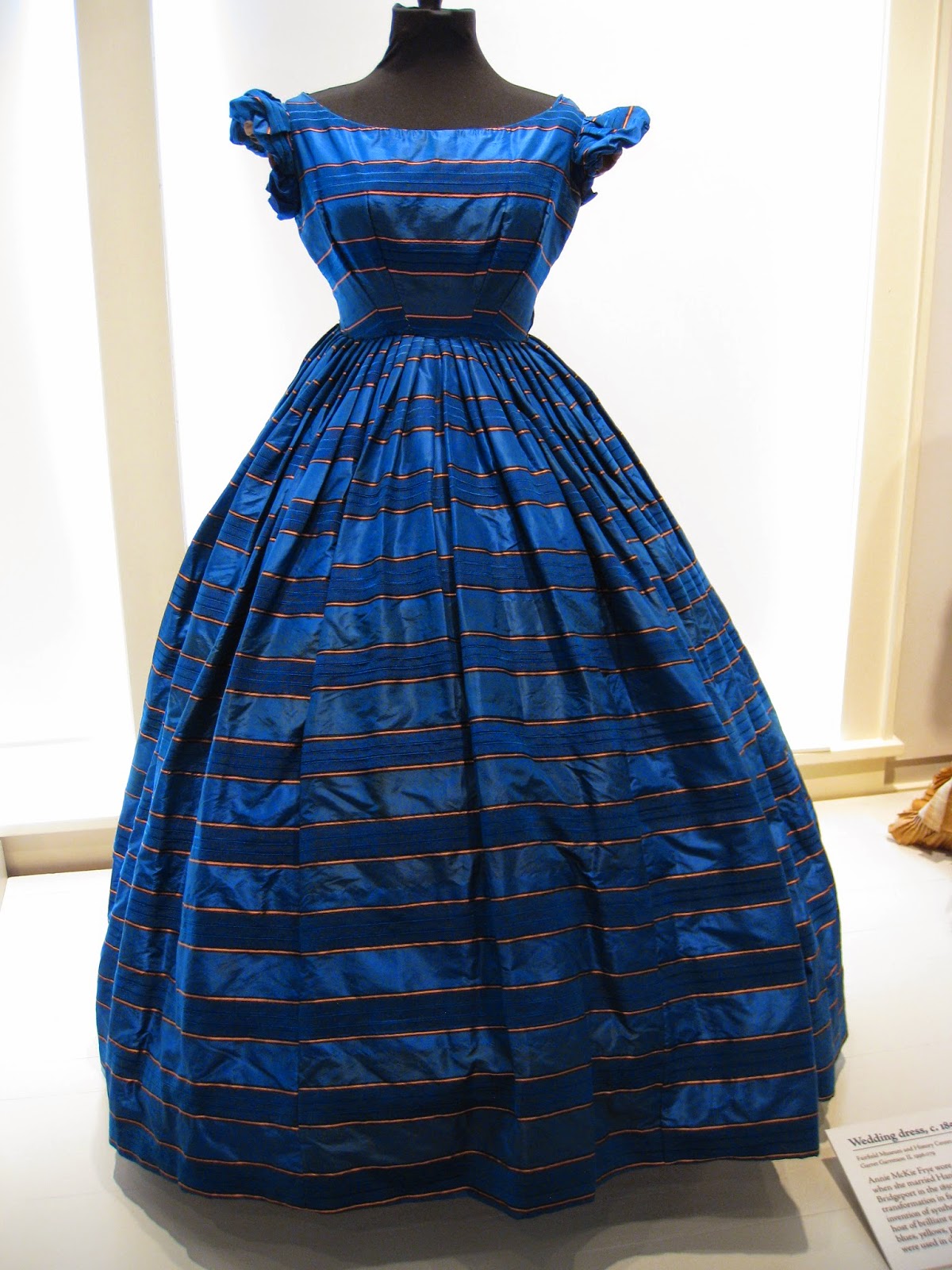
Annie McKie Frye wore this dress when she married Hanford Lyon around 1850. The invention of synthetic dyes allowed for bright colours and the railway facilitated the distribution of the sewing machine and fashion magazines, making such a dress fall into the price range of the middle class!
 
Queen Victoria made the white wedding dress popular and it has since become traditional to wear white. It is also tradition to wear something blue, have something old and something new. The blue was often the wedding garter which came into fashion in nineteenth-century England.


I hope you take the time to visit a local historical society near you and see what they have in their collection. It is especially fun to go with friends and enjoy a lunch or afternoon tea afterwards!

Wednesday, June 8, 2011

Royal Wedding Dress

It was announced the Duchess of Cambridge’s Wedding Dress, veil, tiara, diamond earrings and shoes are to go on show when Buckingham Palace opens for the summer this year, between 23 July and 3 October. Entry price £17.50 and part of this entry fee will go to charities of the Duchess’s choice. The previous opening times have been extended by 45 minutes because of the extra numbers expected and tickets can be booked at http://www.royalcollection.org.uk/.


So if you are heading to the UK and London you might just want to book your ticket to see the wonderful dress first hand (and don't forget if you go to check out the lace around the skirt and train made by the Cluny Lace Co. featured in the current issue of SAGANews!).