Showing posts with label Judith Adams. Show all posts

Sunday, August 26, 2018

What sewing tool do you carry everywhere and why?


Let's find out what sewing tool our teachers take with them everywhere.


Judith Adams:

Tapemeasure. So when out shopping I can measure clothes. My kids give me orders for shirts etc. when I am away so this way I can compare to ones I know fit.

Kathy Awender:

I always try to keep a measuring tape in with me. It has come in handy so many times for so many reasons.

Jeannie Baumeister:

My most favorite stitching tool (besides scissors and needle of course) is the Thimble. I carry it with me for any type of sewing.  I don't know how anyone stitches without one.  It makes your stitching so much faster.  I think everyone should use one.  If you learned to use a fork….you can learn to use a thimble!


Tess Ellenwood:

Scissors.  You never know when you’ll need to cut something. I once got stopped at a security check with six pair of scissors (dress shears, not little thread snips) in my purse. The officer knew there was something wrong with me; but back then, scissors weren’t against the rules, so they let me go. I had been teaching a class at lunch.  You can never have too many scissors.  My name is probably still on a list somewhere.


Cindy Foose:

I am never without my sharp-pointed embroidery scissors. The crown jewel of a stitcher’s treasure chest is a fine pair of scissors sheathed in a pretty case. Actually, I usually have a couple of different kinds of scissors at the ready. Why? Snipping close and with precision is paramount for many finishing techniques.

Susan O’Conner:

Well I can’t say scissors as you still can’t carry those on Australian domestic flights so I would have to say a needle.


Vaune Pierce:

A 6 inch ruler and a pair of small embroidery scissors.  Because you never know when you are going to need them.  The craziest place that I had to make use of them (the scissors) was when I was boating on Shaver Lake with some girlfriends.  We had stopped the boat near the beach and spent the afternoon chatting and (of course) eating.  When it was time to leave, we realized that the anchor rope got caught in the propeller and we had to go underwater and cut the rope a little bit at a time so we could free the propeller to get home.


Tuesday, August 14, 2018

What is the biggest enemy to your creativity?


So today we find out what it is that hinders our teachers in their design work.


Judith Adams:

Probably time. Design Show used to force me to create a special garment each year as I felt it was both a wonderful opportunity and it was a tangible way for me to support SAGA. This year felt very strange as I did not have the panic of creating a garment in perhaps the month before I left for Convention! And this year was the only year I had actually planned what to do 12 months before and designed it in my head after buying a heavily embroidered ribbon at the Houston Quilt Show. The dress with the smocking echoing the design on the ribbon-,that would in turn be the sash looked wonderful in my head! Perhaps another year!


Kathy Awender:

Time. There are so many things I want to stitch, and I keep adding to the list, but I never seem to have enough time to catch up.


Tess Ellenwood:

House work!


Cindy Foose:

Housework and the computer. Dust, dirty dishes, and laundry all work in tandem to stymie my creative efforts along with the time-gobbling gremlins of email, Pinterest, Facebook, online videos and an occasional game of Candy Crush.


Susan O’Conner:

Not enough time.


Vaune Pierce:

My biggest enemy to my creativity is not having enough time, as I am sure we all can relate!  When I am designing something, I usually have the basic idea at the beginning, but as I work on it, my best creative work comes as I am sleeping.  The ideas that I get when I am sleeping are what make my designs go from good to great, at least in my eyes. 


Monday, July 30, 2018

What inspires your designs?


Some of our teacher who will be at the SAGA Convention in Winston-Salem tell us how they are inspired.


Judith Adams:

Anything I see that has a regular shape may “plant a seed” for a smocking plate, or it could just create a theme in my mind, such a “bows”. I always come away from SAGA Convention or a workshop feeling inspired to create. I think it is being surrounded by ladies that are just so enthusiastic about smocking and it makes me try and think “outside the box”.


Kathy Awender:

So many things! I have been inspired by advertisements, color combinations, and of course by fabric that begs to made into something special. I also have collections of antique magazines, patterns, clothing, hankies and other textiles and I often look to them for inspiration.


Jeannie Baumeister:

My designs are mainly inspired by old things.  I love old baby clothes.  I examine old baby garments for inspiration and am lucky that many people share their treasured baby clothes with me. Many of my designs/patterns and classes came from garments shared with me.   I am especially drawn to the styles from 1900 through 1940's.


Tess Ellenwood:

Absolutely everything!  One time I based a design on a bar of soap.  When we went to the beach, I took a picture of the dime-store rug in the entranceway of the beach house rental because I really liked the palette; everyone else was snapping pictures of the ocean. Once, a furniture ad inspired a vest.  When I walk through my yard, I take time to look at the really tiny wildflowers, count their petals, and decide which stitches they could be.  I tend to see tiny pieces of things, not necessarily the whole.  I really have a different drummer (maybe we all do, but just don’t realize it), and I like to push the envelope.  As a consequence, I try a lot of stuff that just doesn’t work J


Cindy Foose:

This question makes me laugh! I wish I knew the answer to this question. If pressed for a real answer, I would have to say that visiting museum collections of antique clothes and perusing vintage photos and patterns of children’s clothing. Inspiration can be anywhere; you just have to open your mind to all possibilities.


Susan O’Conner:

All sorts of things – historical embroidery, flowers, periods in history, poems and stories.


Vaune Pierce:

A fabric, a color, a shape. 


Monday, July 9, 2018

Who taught you needlework skills and when did you first start learning?


Some of the teachers who will be teaching at the SAGA Convention in Winston-Salem answer that question.


Judith Adams teaching at a SAGA event.
Judith Adams:

I have some pieces of petit point that I worked when I was 10 or 12 but can’t really remember much about them.When I lived on an Australian Air Force Base (my husband was the Senior Dental Officer at the time ) we had a USAF exchange officer and his family living there and I was taught by the officer’s wife. I was pregnant with my daughter at the time (1984) and loved smocking and bought a pleater immediately. 


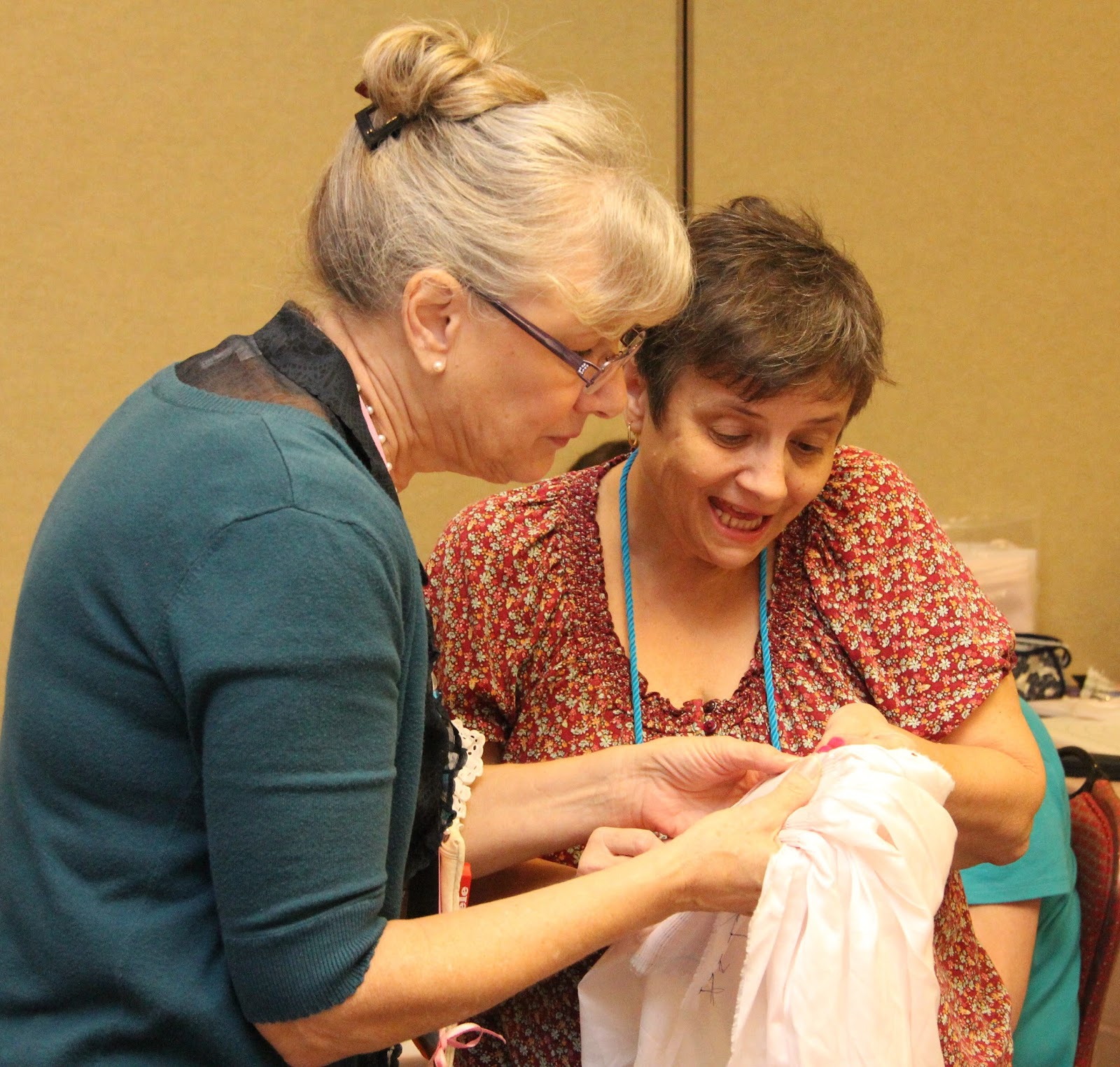
Kathy Awender, left, helps a student at a SAGA event.


Kathy Awender:

My mother, aunt , grandmother all taught me different things. My mother always sewed for all five of her daughters, and I was very excited when she finally taught me how to use the sewing machine just before seventh grade. That is when I started making my own clothes. My grandmother taught me to embroider and an aunt taught me to knit and crochet.

Jeannie Baumeister (right) with Susie Gay

Jeannie Baumeister:

My Mother taught me to sew using her Featherweight Sewing Machine (it is now my Featherweight Sewing Machine) and my favorite color is always Blue!


Tess Ellenwood on the right

Tess Ellenwood:

 As a child, I was surrounded by grandmothers, aunts, and a mom who could sew, knit, crochet, and tat.  Even my dad was accomplished at picking up dropped knitting stitches.  My earliest sewing memory is from when I was little more than two.  My mom had cut the feet from my pajamas because they had gotten too short. I got up in the night, found a needle in the sewing box (it must have been already threaded), and attempted to sew the feet back on.  I’ve been stitching ever since.  


Cindy Foose:When I was about five-years-old, my Aunt Carrye decided it was time for me to learn to do simple embroidery. She believed that every home should have embroidered cup towels and/or fingertip towels. Her long suit was lazy daisy flowers, French knots, and stem/outline stitches all of which graced many items in her home. Guided by her early, gentle instructions I found a lifelong passion. My construction skills have evolved over the last sixty years by applying what I describe as “The Three Ps” – patience, practice, and perseverance. Successes coupled with failures have bred an ongoing determination to improve and hone all my needlework/sewing skills. This quest keeps me awake at night!


Susan O’Conner:

My mother taught me basic embroidery stitches when I was a child. As I really enjoyed embroidery I then learned other stitches and techniques from books and classes.


Vanue Pierce, centre, teaching at a SAGA event.


Vaune Pierce:

For VERY basic embroidery – self-taught with Simplicity embroidery transfers onto a chambray shirt (this was in the 70's).
'Heirloom Embroidery' - the first class I took was Bullions from Julia Golson and made lots of nice grubby worms.  The embroideresses in Madeira on the two times I visited, along with Lillie McAnge were instrumental in the embroidery that I do now.

So who taught you to sew?


Monday, May 7, 2018

Some Go-To Videos

If you are just beginning smocking and would like to learn some basic smocking techniques then the Smocking Arts Guild of America YouTube videos are a great way to learn.

The videos feature teachers Judith Adams and Vaune Pierce who take you through the  process of pleating your fabric and two basic smocking stitches, cable and trellis.

Watching the videos is like taking a mini class with these teachers and all in the comfort of your own home!

Even if you know how to smock,  you will pick up some great tips from watching these videos!

Judith Adams Pleating Your Fabric

Vaune Pierce Cable Stitch

Vaune Pierce Trellis Stitch

These videos would be good to watch as there is a new  SAGA Smock Along coming soon to celebrate 35 years of the Artisan Program and it might be good to brush up on the basics and be ready to Smock Along!


Tuesday, January 10, 2017

Classes for everyone!

There are classes to suit everyone at the SAGA Boston Retreat (March 31-April 2, 2017).


You can smock with Judith Adams and Kathy Awender; do fine embroidery with Jeannie Baumeister, Susie Gay and Kathy Awender; take machine classes with Trish Smith and Cindy Foose. Learn how to design and make boys garments; make a linen press; make baby clothes; make a handbag; make a Christening gown or a little (or bigger) girls dress.

Have you checked out the brochure? It is available for download at the SAGA website www.smocking.org

Registration is easy on line.

Don't forget to book your hotel room ( the link on on the SAGA website www.smocking.org)

Hope to see you there!